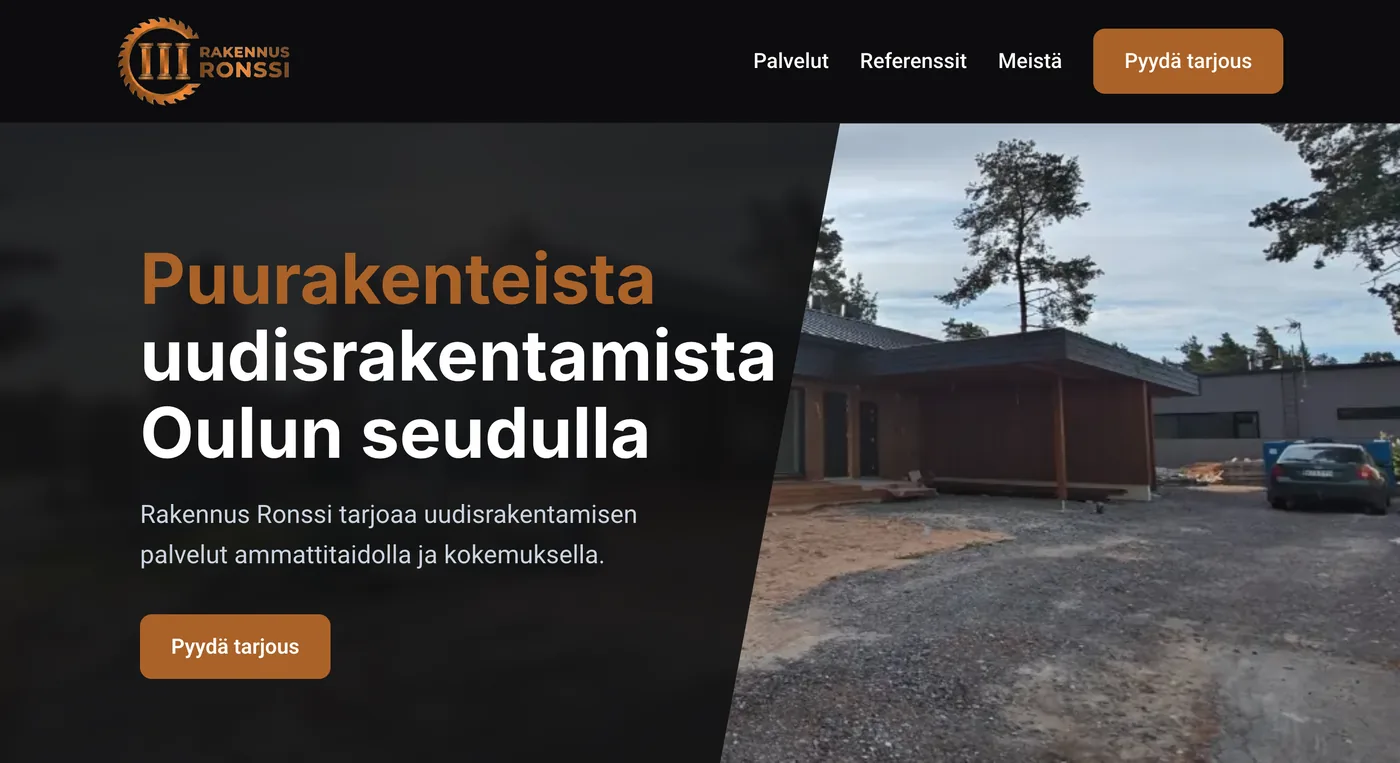
Why doesn’t your website bring in enquiries?
The short answer: the reason is rarely how the site looks. Enquiries don’t come in because the site doesn’t answer the customer’s questions, can’t be found on Google with the right keywords, loads too slowly or doesn’t guide the visitor anywhere. Design is part of the whole, not a substitute for it.
In this article I go through the most common reasons why a website doesn’t bring in enquiries, and what you can do about each one.
1. The site looks good but doesn’t answer the customer’s questions
Before customers get in touch, they want answers. Not a sales pitch, just ordinary practical information: what you do, whether it suits their situation, where you operate, whether they can trust you, how to reach you and what happens next.
If these are left open, the customer won’t stick around to call and ask. They move on.
I see this with my clients all the time, and it’s especially true in service businesses. A renovation company’s customer wants to see what projects have been done and how a quote works. A plumbing and HVAC company’s customer wants to know whether you do servicing, contracting or both, and in which area. A car repair shop’s customer wants to know what servicing is offered and how booking works.
Good design makes the visitor stay for a moment. That moment is wasted if the site doesn’t use it to answer what the visitor actually came to ask.
2. Your services are described too vaguely
The most common single problem is this: services are described in general terms, with no depth. "Versatile renovation services" may be true, but it tells nothing to a customer who is looking specifically for a bathroom renovation, a roof renovation or a facade refurbishment.
Nor does it tell Google anything. Both are left guessing.
When every service is described with the name customers actually search for, the guessing stops. Service-specific pages help in three ways:
- Google understands better. A single service page can be matched directly to a customer’s search.
- The customer finds the right service. Visitors don’t have to guess whether you do exactly what they need.
- The enquiry can be targeted. A quote request for a roof renovation can ask different questions from one for a bathroom renovation.
A business with clear service pages is found with more keywords and convinces customers faster. A business with one general list of services competes against everyone and doesn’t really win against anyone.
3. The site isn’t found where customers are looking
A site can exist and be indexed by Google, yet still be invisible for the searches customers actually make.
If a plumbing and HVAC company in Oulu wants customers, it isn’t enough for the home page to say "HVAC services". The site has to support searches like "HVAC servicing Oulu", "pipe renovation for housing companies" or "HVAC contractor Northern Ostrobothnia". If a cleaning company serves several customer groups, it should have separate pages for, say, office cleaning, construction cleaning and cleaning for housing companies.
In practice, visibility is built by:
- service-specific pages that match real searches
- an area and city structure that supports local visibility
- a clear heading hierarchy and proper metadata
- logical internal linking between services and areas
- search-engine-friendly URLs
- enough content to answer the customer’s questions
SEO isn’t a separate project glued on top of a finished site. It’s part of the site’s structure. When the structure is right, visibility is already half done.
4. The site is too slow
When a customer opens your site on their phone and it loads in fits and starts, they don’t think "poor technical optimization". They think the business seems outdated or unreliable.
This is especially true in local service searches. When a customer looks for a builder, an electrician or a repair shop on their phone, they compare options in seconds. Nobody waits for a slow site.
Slowness is usually caused by:
- a heavy ready-made theme that loads everything at once
- dozens of plugins, each with its own scripts
- large, unoptimized images
- unnecessary code generated by a page builder
- a server that can’t handle the load
A properly built site gives you a better starting point than a heavy off-the-shelf solution. When the site isn’t weighed down by themes and plugins, speed is a built-in feature, not something patched afterwards.
5. Getting in touch is too hard on mobile
A large share of service searches happen on a phone. If a customer finds your business on Google but the mobile view is messy, they won’t get in touch.
Typical problems:
- the phone number isn’t tappable
- the contact form is too long or doesn’t work
- the main call to action is buried at the bottom of the page behind long scrolling
- the navigation leads to the wrong places
- heavy images and animations slow the page down
The decision is made in a few seconds. If getting in touch doesn’t take just two taps, a call or a form, the customer is already on their way to a competitor.
6. The visitor isn’t guided anywhere
A site can have dozens of "Contact us" buttons. Yet none of them work if the visitor isn’t convinced yet.
Visitors only get in touch when three things are true:
That means you need content before the button: a service description, case studies, an explanation of how the process works, trust signals and answers to the most common questions. Place the call to action where the visitor is ready to move forward – not just at the top and bottom of the page.
A button isn’t a magic word. It’s the last step on a path that has to be built before it. We went through this path in more detail in the article is your website losing customers.
7. You don’t know where visitors drop off, because you don’t measure
Most people miss this one. Many business owners know their site doesn’t bring in enquiries, but nobody knows why, because nobody measures anything.
Without measurement, you fix symptoms, not the cause. You change colours, move buttons and guess. Once your site has even lightweight visitor tracking and form tracking, you start to see the real bottlenecks: which pages visitors land on and where they leave.
A single insight – for example, that half your visitors leave while looking for prices – can tell you more than a complete redesign. Develop your site based on what visitors actually do, not on how it feels to you.
8. The site looks the same as all your competitors’
Many sites built on ready-made themes look the same as the business next door: the same layout, the same stock photos, the same vague service descriptions. When a customer compares three renovation companies and every site looks the same, they have no reason to choose any of them.
Standing out doesn’t mean fancy animations or loud colours. It means the site clearly says what you do better or differently, and proves it with case studies, a description of your process and real photos of your own work. One honest photo of a finished job convinces more than ten smiling stock-photo people.
What kind of website brings in enquiries?
A website that brings in enquiries isn’t a coincidence – it’s the result of design. In practice, you need:
Structure and content
- A clear service structure: every important service deserves its own content, not just a line on the home page
- Service-specific pages that answer customers’ searches directly
- Credible content: case studies, work samples, your process, company details and business ID
Visibility on Google
- A structure that supports local visibility and makes your service area visible
- A clean technical foundation: heading hierarchy, metadata and internal linking
- Search-engine-friendly URLs
Speed and mobile
- Fast loading, especially on mobile
- A working mobile experience: tappable number, short form, visible call to action
- A lightweight technical build without unnecessary baggage
Guidance and measurement
- Calls to action in the right places, where the visitor is ready to act
- Easy ways to get in touch: phone, form and email
- Measurement, so you know what works and what doesn’t
A more expensive site doesn’t automatically bring more enquiries. What matters is that these pieces have been thought through, not how much the site cost. We’ve written separately about how much a website costs.
When should you completely redo your website?
You can make individual fixes to an old site too. Sometimes, though, it makes more sense to start from a clean slate. It’s time for a redesign if several of these apply:
- the site brings in no quote requests or enquiries
- the site can’t be found for important keywords
- the site loads slowly on mobile
- the service structure is unclear or outdated
- the content doesn’t match your current services or customers
- competitors look more credible online
- the site is hard to update or expand
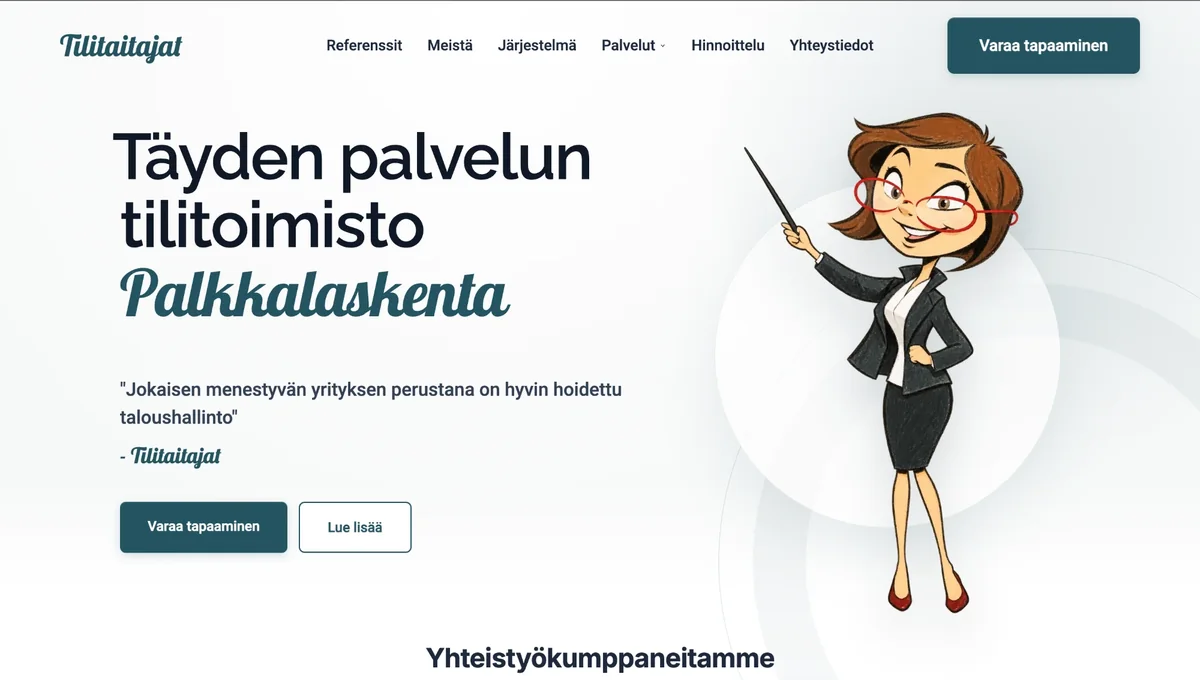
If these are true of your website, surface fixes usually won’t get you there. Then it’s worth looking at the whole: structure, content, speed, the technical foundation and the path the visitor follows towards getting in touch. You can see an example of this kind of redesign in the Tilitaitajat case study.
Does your website get visitors but no enquiries?
If you recognise several of the reasons above in your own site, the problem is rarely just one thing. It’s usually a combination of structure, content, speed and the buyer’s journey.
If you’re not getting enquiries, send me a message. I’ll make you a free demo of a page built to bring in enquiries, so you can see in concrete terms what makes the difference.
Want to see what a website that brings in enquiries would look like?
Explore the free demoFrequently asked questions about a lack of enquiries
Why doesn’t your website bring in enquiries?
The reason is rarely how the site looks. Enquiries don’t come in because the site doesn’t answer the customer’s questions, can’t be found on Google with the right keywords, loads too slowly or doesn’t guide the visitor anywhere. Design is part of the whole, not a substitute for it.
Why can’t the site be found on Google with the right keywords?
A site can be indexed and still be invisible for the searches customers actually make. Visibility is built by service-specific pages, an area and city structure that supports local visibility, a clear heading hierarchy, proper metadata, logical internal linking and search-engine-friendly URLs.
Why are service-specific pages important?
A vague list of services leaves both Google and the customer guessing. When every service is described with the name customers actually search for, Google understands the page better, customers find the service they need and the enquiry can be aimed at exactly that service.
Does website speed affect the number of enquiries?
Yes, especially in local service searches. When a customer looks for a builder or a repair shop on their phone, they compare options in seconds and won’t wait for a slow site. Slowness is usually caused by a heavy ready-made theme, dozens of plugins, unoptimized images or unnecessary code generated by a page builder.
How should getting in touch work on mobile?
The phone number should be tappable, the form short and working, and the main call to action visible without long scrolling. If getting in touch doesn’t take just two taps, a call or a form, the customer is already on their way to a competitor.
When should you completely redo your website?
It’s time for a redesign if the site brings in no quote requests, can’t be found for important keywords, loads slowly on mobile, has an unclear service structure, has content that doesn’t match your current services or is hard to update. When several of these apply, surface fixes usually won’t get you there.